




Interview Thijs Blom, data analyst at RIWA-Meuse: “This tool gives us an insight into the spread of harmful substances in the Meuse.”
Which harmful substances have been present most in the river water in the Meuse basin in recent years and where? Also, what is the best way to analyse these trends to be able to tackle the presence of the pollutants in question? Four trainees from the National Water Traineeship developed a tool for this purpose.
A number of substances in drinking water sources are particularly difficult for drinking water companies: substances that can be harmful to human and animal health, are difficult to clean up and are frequently detected during monitoring activities. For example, industrial pollutants, consumer products, medicines and various pesticides.
The Clean Meuse Water Chain (SMWK), a partnership between drinking water companies, water boards, Rijkswaterstaat, the Ministry of Infrastructure and Water Management and RIWA-Meuse, wants to reduce the presence of these types of micropollutants in the Meuse. Micropollutants is the umbrella term used to identify a large group of substances with various applications and varying chemical properties. The aim is to achieve a reduction of 30% by 2040 compared to 2023, the year when the SMWK’s joint monitoring network was launched. To determine whether this has been achieved, the SMWK is measuring 38 substances at 30 monitoring points at least four times a year.
Four trainees from the National Water Traineeship developed a tool for this purpose. “The tool shows how far we’ve come with the reduction envisaged,” explains Thijs Blom, the project leader. “Are we now seeing an increase in the concentration of a particular substance in the Meuse, or is it decreasing? Are we on the right track? And are we focusing on the right substances?”
Three types of substances and locations
The study examined the 38 substances collectively measured by the SMWK; they can be broken down into three categories: Firstly, Industrial pollutants and consumer products; secondly, Residues of pharmaceuticals and endocrine-disrupting chemicals and, thirdly, Plant protection products, biocides and their metabolites.
There are also three categories of locations. Firstly, the monitoring points in the surface water points: 19 locations in the Meuse, where the water boards, drinking water companies, Rijkswaterstaat or the Flemish Environment Agency conduct measurements. Secondly, the monitoring points at four abstraction points, where drinking water companies WML, Dunea and Evides abstract water from the Meuse for drinking water production. Thirdly, the effluent from five wastewater treatment plants, where water boards treat municipal wastewater.
Hotspots
The tool contains data from 2019 to 2023 inclusive. It was obtained from RIWA-Meuse measurements and the SMWK, which started its measurements in 2023, in the river and its tributaries.
The aim is for the tool to visualise trends: the concentrations in which substances are present in the three categories and where the hotspots are (in other words, the locations where the most breaches are measured). Blom explains: “This will enable us to specifically set out to find sources of pollution, with the aim of reducing the presence of these substances.”
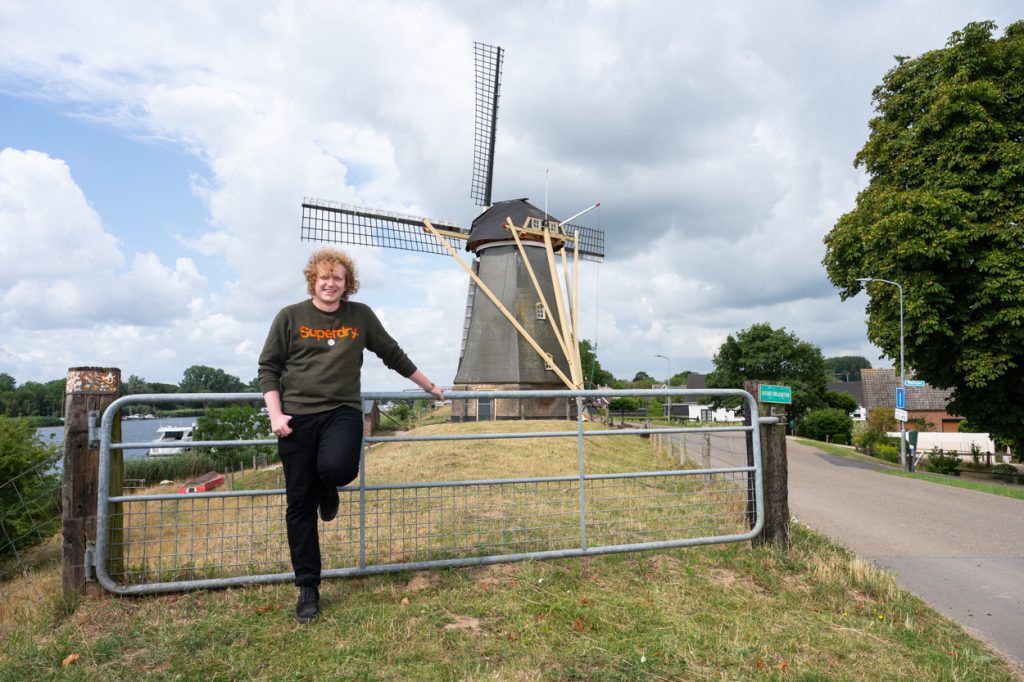
Thijs Blom, data analyst at RIWA-Meuse.
Glyphosate
The study focuses on three categories of substances and three types of locations. The researchers have developed a dashboard for all 38 substances at the 29 monitoring locations.
The researchers focused on the plant protection product glyphosate, a widely used and controversial herbicide, which the EU recently authorised for another 10 years and that Blom studied during his traineeship last year (see p. 44 of the 2023 annual 44). By law, drinking water companies are prohibited from producing drinking water from ground or surface water containing more than 0.1 micrograms per litre of plant protection product.
PFOA and a painkiller
The second substance that researchers studied was PFOA, a chemical substance from the group of PFAS, of which there are thousands of variants. This type is widely used in various products and has been on the European list of Substances of Very High Concern since 2013. RIVM lists numerous harmful effects on health.
The third substance is the medicine diclofenac, one of the most commonly prescribed painkillers, which also has anti-inflammatory properties. Like other medicines, its residues end up in rivers, including the Meuse, via the sewage system and wastewater treatment plants. RIVM research shows that the substance is harmful to aquatic life.
Analysis of the data
Blom explains that you can use a dropdown menu in the tool to filter by substance, substance category and monitoring-point category. “The result is an overview of all the substances and locations that fall within the filters selected. For example, you can see the concentrations of medicines at surface water points and whether you are meeting your reduction target.” There is also a tab that shows the substances measured on a map of the Meuse river basin.
The SMWK monitoring and interpretation working group (werkgroep Monitoring en duiding) is currently analysing the data in the dashboard. Blom: “The results will be available soon. They will show an upward or downward trend line for each substance and we will be able to clearly see how close we are to achieving our reduction targets.”
Trends in the Meuse
Results that Blom can already see: “It’s clear that glyphosate levels have been decreasing in the Bergsche Maas in recent years. The trend line for PFOA is almost horizontal. There’s a slight upward line; no real downward trend is observable yet. A high level of seasonality applies in respect of diclofenac; on average, the substance is not decreasing significantly in the Bergsche Maas. SMWK will continue its monitoring activities in the years ahead. Blom: “Trends will become even clearer once we have five years of uniform data from the SMWK monitoring network.”
Text: Thessa Lageman, Onder Woorden
Translation: KERN Rotterdam
This interview is published in the RIWA Annual Report 2024 The Meuse