



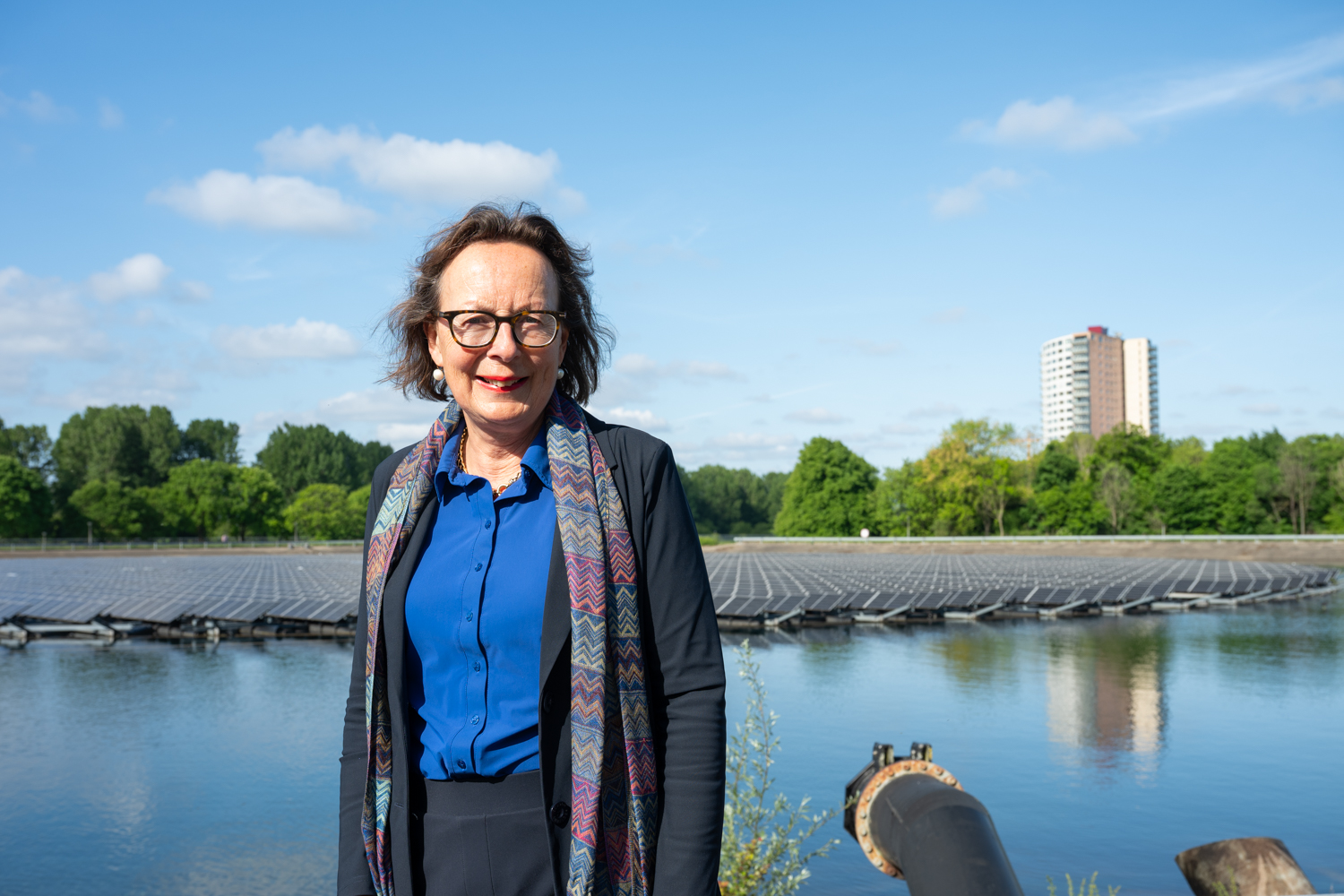
Interview Annette Ottolini, General Manager of Evides Water Company and board member of RIWA-Meuse: “We could do with being a little more activist in our approach.”
Which challenges has Annette Ottolini come up against in recent years and how does she view the future? Before stepping down from both of the roles above, we asked her to reflect on her past and future. "The time has come to bang the drum harder. We can't be patient for much longer."
In recent years, Annette Ottolini has been confronted with numerous challenges in her role as the Managing Director of Evides Water Company and board member of RIWA-Meuse. She has been in both roles since 2014 and is stepping down this year. The challenges in question related primarily to water quality in the Meuse. Eighty-six percent of the drinking water that Evides produces for 2.5 million consumers and businesses in the south-west of South Holland, the south-west of North Brabant and in Zeeland is produced from Meuse water, 4% from the Haringvliet and 10% from groundwater.
Abstraction stop
The biggest challenge happened 10 years ago, Ottolini explains: when a measurement revealed the presence of pyrazole in the Meuse. This chemical is used to manufacture medicines, dyes and pesticides. After the mussel monitor sounded an alarm and numerous unidentified substances were found, the water companies stopped their abstraction of Meuse water. “We had a quite lengthy abstraction stop,” Ottolini says.
Evides was unable to abstract water from the Meuse for drinking water production for 25 days. This was the first such prolonged abstraction stop since 1995. “As a result, we eventually found ourselves with just a week’s supply of water for the whole of the south-west Netherlands; it was a crisis and an immediate wake-up call.”
To prevent a situation like this happening again, Evides decided to build a new abstraction pump station, to facilitate the faster abstraction of more water from the river to replenish the reservoir’s water supply after an abstraction stop. The abstraction pump station in question (Bergsche Maas) opened in 2021.
Mussels
When the water level in the reservoirs was continuing to drop in 2015, it also became apparent that there were many mussels on the edges of the reservoirs, Ottolini says. If they dried out, they would rot and the water quality would deteriorate to the point that it was no longer suitable for drinking water production. So, the shape of the reservoirs was modified to stop so many mussels attaching themselves to them; another benefit was that more space was created in the reservoirs.
Although the water company is now better prepared for a crisis like this, Ottolini says: “Water quality in the Meuse isn’t improving. That really worries me. Yes, we can implement abstraction stops and adjust purification methods. But the European Water Framework Directive states that water companies must be able to produce drinking water based on simple purification principles. This is far from the case at the moment.”
Mapping discharges
To change this situation, the SMWK, a partnership of drinking water companies – including Evides, RIWA-Meuse, water boards and central government – that was launched in 2015, developed sound measurement methods. “This allows us to accurately track the exact origin of these discharges,” Ottolini explains. “We then mapped the above in the Atlas for a Clean Meuse.” This document contains all companies’ direct discharges into rivers, ditches, streams and canals. The partnership is now also trying to gain a better understanding of indirect discharges, which enter the river via the sewer and wastewater treatment plants.
In 2015, it was found that the substance pyrazole had originated from Sitech, now Circle Infra Partners, which purifies wastewater from the factories on the Chemelot industrial estate in Limburg. In the years after the pyrazole crisis, discussions took place about the company’s new discharge permit: at the initiative of the Limburg water board, various parties – Evides, Dunea, WML, the province of Limburg and Rijkswaterstaat – worked with Circle Infra Partners to agree on a permit that was workable for everyone.
Ottolini explains this so-called Mutual Gains Approach. “Discussions culminated in what was a very good permit. It contains all the substances that this company discharges and the relevant maximum quantities. The aquatic hazard of the substances – their negative impact on water quality for people, animals and plants – is also measured continuously. The permit includes various calibration and adjustment times, giving it a dynamic character.”
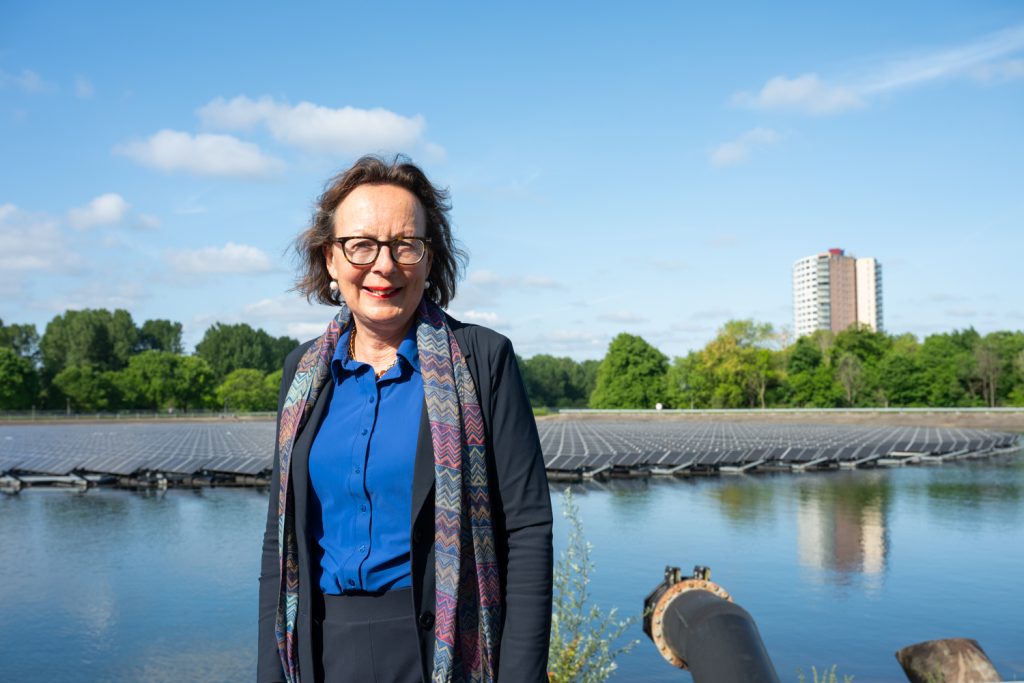
Annette Ottolini, General Manager of Evides Water Company and board member of RIWA-Meuse (Photo: Eelkje Colmjon, Eelk.nl)
Sample permit
Circle Infra Partners was issued with its new discharge permit in 2020. “We had expected to see the wide adoption of this type of permit,” Ottolini says. “Especially because the Association of the Dutch Chemical Industry (VNC) was very impressed by it. Everyone was enthusiastic. Unfortunately, no other companies and competent authorities have followed suit to date.”
Ottolini believes that the authorities responsible for issuing permits ought to be the initiators of a Mutual Gains Approach like this. “I would like to urge the Ministry of Infrastructure and Water Management to develop a policy that requires competent authorities to issue this type of permit.” Rijkswaterstaat and the water boards would issue permits for direct discharges, while the 29 regional environmental services would issue permits for indirect discharges.
In many cases, some of the substances that companies discharge are not currently included in their discharge permits, Ottolini explains. There is a huge backlog in the updating of permits, and permits in the Netherlands are often outdated because they were issued for an indefinite period of time, which means they do not include the current discharge requirements for substances. “In the meantime, a company could have made changes to its production process and now be discharging substances that aren’t included in the permit.”
Always up to date and clear requirements
So, Ottolini says: “We are advocating for permanent wastewater measurements. The beauty of dynamic permits like these is that they are always up to date.” But what about the backlog in permits to be updated? “Some of the competent authorities say they don’t have enough staff,” she says. “But if the permit is designed based on a system with permanent measurements, there are no backlogs and often fewer people are needed.” Are continuous measurements possible? Ottolini believes they are: “The new technologies make it easy.”
The SMWK is currently working on the improved mapping of indirect discharges, which is no easy task. Ottolini also believes that water boards should impose stricter requirements on the wastewater they receive. “And make agreements about this with the companies that discharge via them. The water boards are hard at work on this, but there’s always room for improvement.”
Less diluted
Climate change has been a challenge for Evides in recent years too and will certainly continue to be a challenge in the future. “We commissioned Deltares to conduct a study to determine whether the Meuse will still be an important and reliable source for us in 2100,” Ottolini says. The study shows that the quantity, the availability of fresh water, won’t be a problem, but quality will. “We’re concerned about that. Especially given the new climate scenarios from the Royal Netherlands Meteorological Institute (KNMI), which show a dramatic acceleration in climate change.”
Ottolini mentions the fact that contamination is now increasing: medicine residues, pesticides, plastics, PFAS and other harmful substances and emphasises: “Droughts exacerbate this problem. Because these substances are present in higher concentrations when flow is low and there’s not much water flowing through the river.”
Better source protection
That’s why Ottolini believes a ban on the discharge of SVHCs, a list compiled by RIVM that contains more than 3,000 substances, should be implemented as soon as possible. She adds: “I think it’s wonderful to see rivers here and there around the world becoming legal entities; this makes it possible to protect them.” The first such river was the Whanganui River in New Zealand in 2017.
Ottolini also mentions the precautionary principle: substances must first be thoroughly tested for their aquatic hazard – their harm to humans, the environment and drinking water – before they can be discharged. “It’s a bit crazy, of course, that companies can discharge them freely, leaving us to pick up the pieces afterwards.” Thanks to all the technologies at our disposal, drinking water companies can also turn polluted water into good-quality drinking water, but that costs a lot of money, raw materials, energy and water. “It makes a huge difference if you do it upfront, in advance.”
Leading the way
An assessment of this nature is a smart move for the companies that discharge these substances too, she explains. “If a company knows that discharges are not harmful, it will be future-proof. Then, it’s guaranteed a license to operate.” This means preparing for the upcoming legislation from Brussels and seeking more environmentally-friendly alternatives. “It’s a win-win-win situation for everyone: the companies, the competent authorities and all the parties that use the fresh water.”
Ottilini also mentions the SMWK’s efforts to engage with businesses about the impact of discharges. “This is very important. But if we’re not successful, we will need to take a more proactive approach – we can’t wait too long.”
Higher on the agenda
Which role does Ottolini see for RIWA-Meuse in the protection of the Meuse as a source of drinking water in the future? She returns to the WFD. “It’s remarkable, of course, that it’s been in place since 2000 and that we’ve known what to do for 25 years now. So many things have been postponed time and time again. I think that we, RIWA-Meuse, both alone and with our members, need to become a little more activistic.”
By this, she means: “Put it even higher on the agenda, beat the drum more forcefully and legally enshrine the responsibility of permit providers: make a Mutual Gains Approach mandatory and also the permanent monitoring of wastewater at companies. Ensure an actual ban is in place on the discharge of SVHCs and really make sure the precautionary principle is applied. Make clear agreements and improve adherence to them.”
Ottolini believes that, since 2014, when Ottilini started in the roles she is about to step down from, RIWA-Meuse has definitely put the various issues on the map. She concludes: “I’m pleased with how the association has developed in recent years: it is seeking publicity much more. Having said that, there’s still so much more to be achieved.”
Text: Thessa Lageman, Onder Woorden
Translation: KERN Rotterdam
This interview is published in the RIWA Annual Report 2024 The Meuse